
Corrugated tubing
Corrugated tubing is a protective plastic tube used to enclose cables and pipes. Its primary purpose is mechanical protection, for example against digging damage, rodents, and other external influences. Corrugated tubing is widely used in and around buildings, during groundworks, and for penetrations through walls or foundations. In situations where cables or pipes pass through exterior walls, the use of corrugated tubing is mandatory.
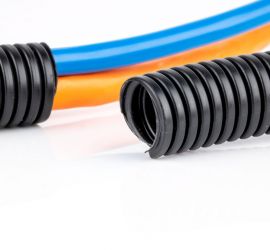
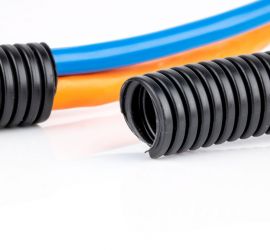
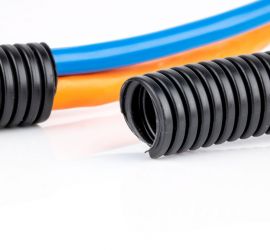
What is corrugated tubing?
Corrugated tubing acts as an additional protective layer around a cable or pipe. The cable does not lie directly in the ground or masonry, but inside a tube that absorbs impact and reduces the risk of damage. This is particularly relevant for installations that need to remain in place for long periods and are not easily accessible later, such as beneath paving or through a façade.
In addition to protection, corrugated tubing can also facilitate replacing or pulling in additional cables, provided the installation is designed with this in mind. Especially for longer routes or installations that may change in the future, this can be a practical advantage.
What is corrugated tubing used for?
Corrugated tubing is used to protect cables and pipes and to create clear, organized routes. In practice, it is found in both new construction and renovation projects, as well as in installations on private property. Typical examples include running power cables to a garage, installing garden lighting, or creating an outdoor power outlet.
Typical applications include:
- Laying electrical cables underground
- Routing cables or pipes through walls and foundations
- Protecting cables in areas with mechanical stress or a higher risk of damage
The exact choice of type and diameter depends on the route, the environment, and the number of cables to be installed. In professional settings, the focus is usually on ease of installation and maintainability.
Types of corrugated tubing
There are several types of corrugated tubing available, each designed for a specific purpose. The most commonly used option is standard corrugated tubing, which is flexible and suitable for most standard installations. In existing situations, where cables are already in place, a split or slotted version may be more practical.
Standard corrugated tubing
Standard corrugated tubing is flexible and used for installing new routes. Thanks to its flexibility, it can be laid through bends, provided sharp kinks are avoided. This type is often chosen for underground cables and wall or floor penetrations.
Seperable / Divisible corrugated tubing
Seperable / divisible corrugated tubing can be opened. This makes it possible to protect existing cables without dismantling the entire installation. This is especially relevant for modifications or repair work, for example when a cable is already in use and you want to add extra protection to the route.
Slotted corrugated tubing
Slotted corrugated tubing is designed for adding cables at a later stage. The slot allows a cable to be inserted without fully opening the tube. This can save time during expansions, provided the situation and route allow for it.
Sizes and diameters
Corrugated tubing is available in various diameters, depending on the number and thickness of the cables to be protected. In our range, you will find corrugated tubing with diameters from 6.7 millimeters to 48.1 millimeters. Choosing the correct size helps prevent installation issues and makes it easier to pull or replace cables later on.
When determining the diameter, consider factors such as:
- The number of cables or pipes running through the tube
- The outer diameter and stiffness of the cables
- The length of the route and the number of bends
- The desired space for pulling in additional cables in the future
Choosing a diameter that is too small makes pulling cables difficult and increases the risk of damage. Choosing a diameter that is too large can be inconvenient at penetrations or connection points. In many cases, it is practical to map out the route and bends first and then select the appropriate diameter.
Accessories and installation aids
When installing corrugated tubing, accessories are often used to keep the installation neat and practical. Which accessories are required depends on the route, the substrate, and the installation method.
Commonly used accessories include:
- Pull cord, to make pulling cables easier
- Bends or elbow fittings, to prevent sharp kinks
- Warning tape, to mark the location above the corrugated tubing
Especially for longer routes, a pull cord helps prevent time loss, particularly when cables need to be added later. Bend fittings help maintain a controlled bend radius, reducing the risk of blockages or damage.
Installation tips and advice
Corrugated tubing only functions properly when it is installed correctly. This starts with a logical route and sufficient space for routing cables. In underground installations, depth plays an important role. A common guideline is to place corrugated tubing at a minimum depth of 60 centimeters, reducing the risk of damage from digging activities.
Practical installation tips include:
- Avoid sharp bends and kinks; keep the route as smooth as possible
- Use bends or elbow fittings where the route requires them
- Prefer corrugated tubing with a pull cord if cables still need to be installed
- Place warning tape above the corrugated tubing to alert future excavation work
For penetrations through walls or foundations, it is important that the tubing protects the cable from abrasion and pressure. A clean, well-fitted penetration helps minimize damage during installation and during operation due to movement or settlement.
Advantages of corrugated tubing
The main advantage of corrugated tubing is protection. Cables and pipes are less vulnerable, reducing the risk of failure and repair work. In addition, corrugated tubing often makes installations more organized and can simplify maintenance, especially when replacement or expansion is required later.
Key advantages at a glance:
- Mechanical protection against digging damage and external influences
- Flexible installation, allowing the route to be followed more easily
- Improved accessibility for maintenance or replacement, depending on the installation
- Greater reliability for penetrations through exterior walls and foundations