
White heat shrink tubing
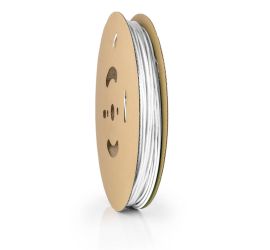
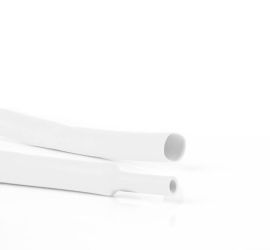
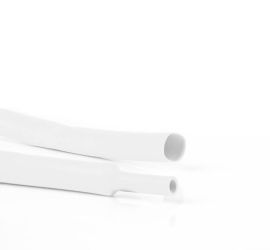
In our range, we offer heat shrink tubing in various colours, including white. White heat shrink tubing is ideal when you want to mark the tubing yourself, for example by writing on it.
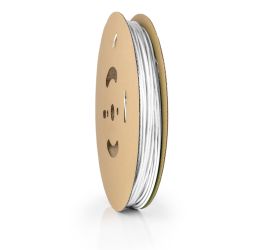
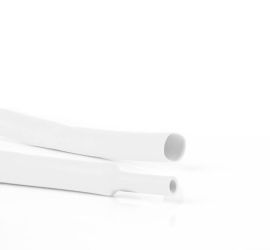
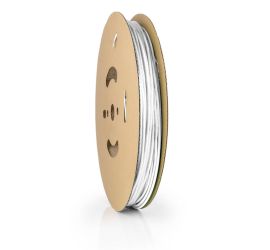
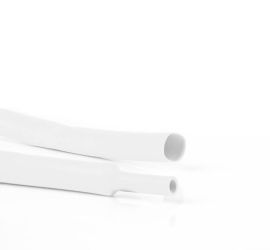
Which types of heat shrink tubing are available in white?
Five types of heat shrink tubing are available in white:
- H-2(Z) – Thin-wall heat shrink tubing – 2:1
- H-2(Z) 2PF – Thin-wall heat shrink tubing – 2:1
- H-2(Z) 3PF – Thin-wall heat shrink tubing – 3:1
- H-2(3X) – Thin-wall heat shrink tubing – 3:1
- H-5(3X)-F – Thin-wall heat shrink tubing – 3:1
Each of these types of white heat shrink tubing is available in various sizes.
Why choose heat shrink tubing?
Heat shrink tubing offers a simple and reliable way to protect, repair and/or mark cables and cable bundles. By cutting the tubing to the correct length, placing it over the cable or cable bundle and then shrinking it by applying heat, the tubing can be installed quickly. Heat shrink tubing provides five forms of protection:
- Mechanical protection – protection against abrasion
- Electrical protection – insulation of the cable
- Thermal protection – including flame-retardant and self-extinguishing properties
- Chemical protection – resistance and protection against acids, salts, etc.
- Environmental protection – protection against weather influences, including water resistance and UV resistance
The degree to which a type of heat shrink tubing provides one or more of the above forms of protection depends on the specific type. Wall thickness, among other factors, plays an important role.
Advantages of thin-wall white heat shrink tubing
All white heat shrink tubing in our range is thin-wall. By thin-wall heat shrink tubing, we mean tubing with a wall thickness between 0.4 and 0.8 millimetres. This is the most commonly used type of heat shrink tubing.
Thin-wall heat shrink tubing offers several advantages compared to medium-wall or thick-wall heat shrink tubing. For example, thin-wall tubing is more flexible and easier to bend. However, the thinner wall also means it provides less protection against abrasion than medium-wall or thick-wall tubing. Thin-wall heat shrink tubing is often used for low-voltage applications.
How do you use white heat shrink tubing?
Have you found the right type of heat shrink tubing with the required level of protection? Then simply follow the four steps below to use heat shrink tubing correctly:
- Determine the correct diameter of the heat shrink tubing. Pay attention to the shrink ratio. If heat shrink tubing with a diameter of 18 millimetres has a shrink ratio of 2:1, it will have a diameter of 9 millimetres after shrinking. With a shrink ratio of 3:1, the diameter after shrinking will be 6 millimetres. Always use heat shrink tubing with a post-shrink diameter that is slightly smaller than the diameter of the cable.
- Cut the heat shrink tubing to the correct length for the section of cable where it will be used.
- Slide the heat shrink tubing over the section of cable where it will be applied.
- Heat the tubing with a heat gun, causing it to shrink. Move the heat source back and forth along the tubing to be shrunk. Continue heating until the tubing has tightly shrunk around the cable.
Applications of white heat shrink tubing
Because cables are often dark in color, white heat shrink tubing can be used—besides providing protection—to easily mark cables. The white color stands out when used on a black cable. The white heat shrink tubing can also be written on or (if desired) printed by us—printing is only possible for the types H-2(Z) 2PF and H-2(Z) 3PF.
In addition, white heat shrink tubing can be used to give dark cables a lighter appearance. When dark cables are used in a space where a lighter color is desired, white heat shrink tubing offers a simple way to achieve this.
Personal advice
Do you have questions about the use, properties or delivery time of our white heat shrink tubing? Or would you like personal advice or to receive a sample? Please contact one of our advisors.