
Heat shrinkable moulded parts
Heat-shrinkable moulded parts are very similar to regular heat shrink tubing. The main difference is their shape: moulded parts are pre-formed, making them suitable for specific applications. Our range includes three types of heat-shrinkable moulded parts:
- Heat-shrinkable cable breakouts
- Heat-shrinkable cable end caps
- Heat-shrinkable cable feed throughs
As mentioned, each type of moulded part has a specific application that cannot be easily achieved with standard heat shrink tubing. Below, we explain the uses of each type.
Heat-shrinkable cable breakouts
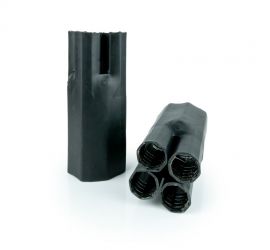
Heat-shrinkable cable breakouts are used to protect cable splits. They consist of a section with a larger diameter and several branches. When you split a cable and want to protect the junction, breakouts are ideal. The main cable goes through the large-diameter section, and the split cables or wires are routed through the branches. The breakout is then shrunk by applying heat. Our heat-shrinkable cable breakouts are available with 2, 3, 4, or 5 branches.
Cable breakouts are made of crosslinked polyolefin and have an operating temperature ranging from -55 °C to 110 °C. The minimum full shrink temperature is +110 °C. They are halogen-free and UV resistant. In addition to shrinking in diameter, breakouts may also shrink in length—by up to 10%.
They include an inner adhesive layer that melts when the breakout is heated, providing a moisture- and dust-proof seal.
Heat-shrinkable cable end caps
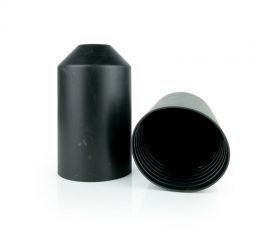
Heat-shrinkable cable end caps are used to seal the ends of cables. An open cable end can pose a hazard or become damaged. End caps provide a safe and easy solution. They are simple to use: choose the correct size, place it over the cable end, and shrink it by applying heat.
End caps share most properties with breakouts: they are made from crosslinked polyolefin, are black, UV resistant, and halogen-free. Their operating temperature range is -55 °C to 110 °C. The minimum shrink temperature is slightly higher than that of breakouts, at +120 °C. End caps also contain an inner adhesive layer to protect the cable end from moisture and dust.
Heat-shrinkable cable feed throughs
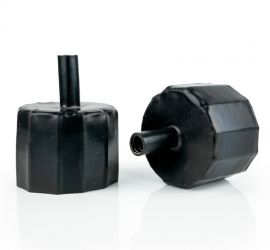
Heat-shrinkable cable feed throughs are used to guide cables that typically exit a larger object—such as a pipe—through a wall or other surface. Cable feed throughs consist of two sections: one with a larger diameter and one with a smaller diameter. The larger section is shrunk over the pipe from which the cables exit, and the smaller section over the cables themselves. This provides a complete seal of the pipe opening. The internal adhesive layer melts when the feed through is heated, ensuring a moisture- and dust-proof closure.
Cable feed throughs share the same properties as heat-shrinkable cable breakouts: they are made from crosslinked polyolefin, are black, UV resistant, halogen-free, and suitable for temperatures from -55 °C to 110 °C. The minimum full shrink temperature is +110 °C.
Personal advice
Not sure which heat-shrinkable moulded part is right for your application? Or do you have questions? Feel free to contact one of our advisors. They’ll be happy to help you make the right choice.