



Installing corrugated tubing: depth, installation and number of cables
Posted on 20 August 2025
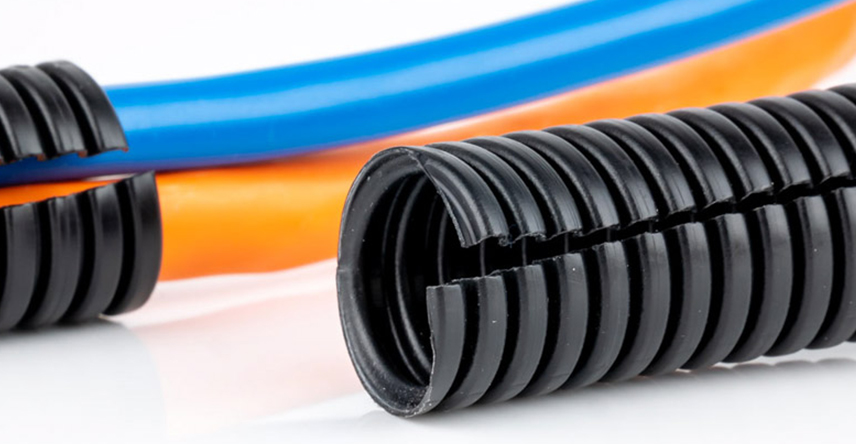
Whether you're laying a cable for garden lighting, an outdoor socket or a complete electrical installation, using corrugated tubing is essential to protect your cabling. Two frequently asked questions when installing corrugated tubing are the following:
- How deep should corrugated tubing be in the ground?
- How many cables are allowed in a corrugated tube?
In this blog we give you clear answers, including useful tips for safe and future-proof installation.
How deep should corrugated tubing be in the ground?
The required depth depends on the type of cable and use. In practice, the following guidelines apply:
| Application | Minimum corrugated tubing depth |
| Garden lighting or outdoor socket | 50 cm |
| Electricity cable to an outbuilding (e.g. shed, garage) | 60 cm |
| Data cabling or low voltage (e.g. intercom) | 30–40 cm |
| Cable under a driveway or path with traffic | > 60 cm, with extra protection such as a protection board or concrete layer |
Tip: Always use warning tape above the corrugated tubing (approximately 20 cm above the pipe). This prevents damage during future excavation work.
How many cables are allowed in a corrugated tube?
There is no fixed maximum number of cables allowed in a corrugated tube, but there are practical and safety guidelines:
Take into account:
Tube filling
The tube may be filled to a maximum of 40 to 60%. This leaves room for ventilation, expansion and (if necessary) additional cables in the future.
Type of cables
Preferably do not combine power cables with signal cables (such as internet or alarm). This prevents interference.
Corrugated tubing diameter
Choose a pipe with sufficient clearance. A standard 19 mm corrugated tubing is suitable for 1 to 2 installation wires. For multiple cables or thicker cores (for example YMVK), use a 32 mm or larger corrugated tubing.
Avoiding bends
The more cables in a pipe, the more difficult it is to pull them through – especially at bends. Rather use a draw spring and lay the pipe with as few bends as possible.
Rule of thumb: Use one size larger pipe than strictly necessary. This makes pulling and replacing cables much easier.
Conclusion
Depth: For power cables, a depth of 50–60 cm usually applies. For other applications such as data cables, 30–40 cm is often sufficient. Under paving or driveways, extra protection is needed.
Number of cables: Ensure that the corrugated tubing is not more than 60% filled and do not combine high voltage with low voltage in the same pipe. Rather choose a pipe that's too spacious than too tight.
Want to be sure which corrugated tubing is suitable for your project? Feel free to contact us – we're happy to advise you!
Also have a look at

WKK chooses FibreStrap: a sustainable solution
Sustainability isn’t in words. It’s in the choices you make as a company.
Everything about bracket holders and types of brackets
In our assortment, you will find a broad range of bracket and clips, such as pipe clips and cable clamps. Read more about the differences between t...