



Releasable cable ties – which types are there and how do they work?
Posted on 17 March 2021
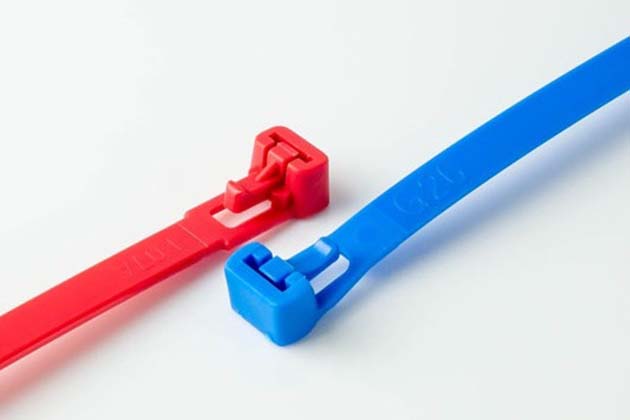
Cable ties are, normally, a product that you use only once: a typical one way product. For example, you bundle a number of cables with a cable tie (also called a zip tie) and when you want to seperate the bundle, you cut the cable tie and throw it away. There is, however, a environmentally friendly alternative: releasable cable ties. But how do releasable cable ties work? Are they just as strong as cable ties for universal use? Read it here!
Types of releasable cable ties
Releasable cable ties are available in two types, or: with two types of closing mechanisms. The type of closure depends on the width of the cable tie. Releasable cable ties with a width of 3,6 mm or 4,8 mm have a closing mechanism, with which the cable tie can be released, located on top of the head of the cable tie. Releasable cable ties with a width of 7,6 mm can be released using the closing mechanism below the head of the cable tie. See figure 1 for both closing mechanisms.
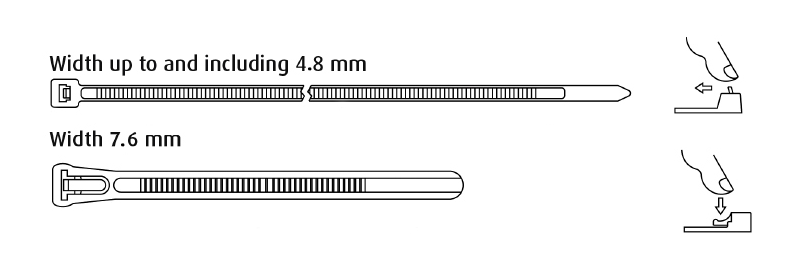
Figure 1
How do releasable cable ties work?
Releasable cable ties are, for the biggest part, used in the same way as cable ties for universal use, with one big difference: after applying the cable tie, you do not cut off the end of the cable tie that ‘sticks out’. If you were to do so, you cannot use the releasable cable tie for other applications later on.
Do you want to release the cable tie? Then you the closing mechanism on top of the head of the cable tie (when using a releasable cable tie with a width up to 4,8 mm) or push the closing mechanism (when using a releasable cable tie with a width of up to 7,6 mm). You can then easily pull the end of the cable tie through the head of the cable tie.
Releasable cable ties versus cable ties for universal use – the advantages and the disadvantages
Releasable cable ties offer a good, environmentally friendly alternative for cable ties for universal use, which can only be used once. Why would we then not always use releasable cable ties? There are a number of reasons.
It is important to mention that releasable cable ties have a tensile strength comparable to that of cable ties for universal use. They are both made of the same material (polyamide 6.6) and the locking barb (the plastic part of the head of the cable tie that ‘locks’ the cable tie) is strong enough to endure a tensile strength of up to 22,2 kilograms. Releasable cable ties are therefore not inferior to regular cable ties. Only regular cable ties with a width of 7,6 mm or larger have a higher tensile strength than releasable cable ties, with a maximal tensile strength of 114 kilograms.
Then where is the difference, you might ask. There are two main differences that are important: the difference in price, and the way in which cable ties are normally used. Releasable cable ties are more expensive than regular cable ties. For a packing unit of 100 releasable cable ties, in the color ‘natural’ and with a width of 3,6 mm and a length of 140 mm, you pay around € 2,61 excl. VAT. For a packing unit of 100 regular cable ties with the same specifications, you pay around € 1,42 excl. VAT.
The other reason why regular cable ties are often preferred over releasable cable ties, is the way in which cable ties are used. For a lot of applications, re-using a cable tie is not needed. When a cable tie is, for example, used in a car or an airplane, the cable tie will never be cut or released. In the rare case where the cable tie is replaced, it is incidental: the use of regular cable ties is then still more cost friendly.
Nevertheless, there are still plenty of applications where releasable cable ties are a lot more suited than regular cable ties: one can think of offices, mounting banners or bundling cables in environments where the bundle is likely to be changed later on.
Would you like to know more about our range of releasable cable ties? View our full assortment here!
Also have a look at

WKK chooses FibreStrap: a sustainable solution
Sustainability isn’t in words. It’s in the choices you make as a company.
Everything about bracket holders and types of brackets
In our assortment, you will find a broad range of bracket and clips, such as pipe clips and cable clamps. Read more about the differences between t...